top of page

NATIONWIDE ADA DEFENSE
1000+ ADA LAWSUITS HANDLED &
20+ YEARS OF ADA LITIGATION &
100% ATTENTION TO YOUR CASE.
WATCH OUR ADA LAWYER DISCUSS ADA LAWSUITS ON 60 MINUTES WITH ANDERSON COOPER:
NATIONWIDE ADA LAWSUIT
PREVENTION AND DEFENSE
The Americans with Disabilities Act (ADA) was enacted to ensure equal access and opportunity for individuals with disabilities. Under Title III of the ADA, businesses operating as places of public accommodation must remove physical and digital barriers that hinder accessibility. While the law’s intent is clear, its enforcement has increasingly relied on private litigation, leading to a dramatic nationwide surge in ADA lawsuits and demand letters, often directed toward small businesses.
For business owners, commercial landlords, and property managers, receiving an ADA demand letter or lawsuit is a serious legal and financial matter. These claims often require businesses to come into compliance with the Americans with Disabilities Act, pay their own legal counsel, compensate the plaintiff's attorneys, and potentially pay statutory damages in places like California and New York. The landscape of this litigation is highly regionalized, driven by specific state laws that interact with federal ADA mandates.
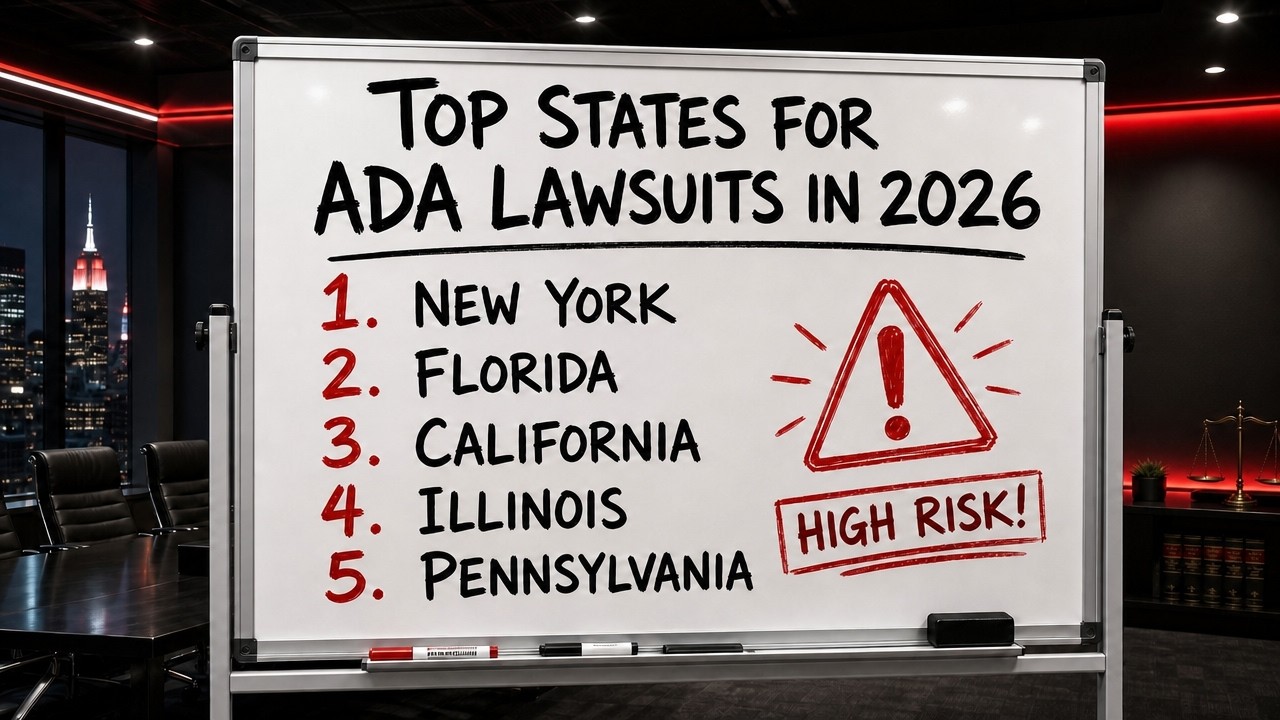
Understanding this legal environment is essential for risk management and operational continuity. Plaintiffs and their legal representatives strategically and serially target certain states, counties, and cities based on favorable local statutes and judicial precedents. Consequently, a business located in a high-litigation state (Florida, New York, California, etc.) faces a statistically higher probability of encountering a web accessibility claim or a physical barrier lawsuit.
Understanding the Surge in ADA Litigation
Over the past decade, the volume of ADA Title III lawsuits filed in federal and state courts has consistently broken records. Plaintiffs frequently file "drive-by" lawsuits, where individuals visit multiple businesses in a single day, identifying minor technical violations of the ADA Standards for Accessible Design. Additionally, the rapid rise of digital accessibility claims—lawsuits alleging that a company’s website or mobile application is incompatible with screen-reading software—has expanded the scope of litigation far beyond physical storefronts.
A demand letter increasingly precedes a formal lawsuit. This legal document outlines the alleged accessibility barriers and demands a financial settlement, along with an agreement to remediate the property or website, in exchange for a release of claims. If the business fails to respond or negotiate effectively, the plaintiff will file a formal complaint in state or federal court. The financial burden of defending these claims can be substantial, making proactive compliance and aggressive legal defense paramount.
High-Volume States for ADA Lawsuits
Certain regions experience a disproportionate share of ADA litigation due to state-specific civil rights laws that provide monetary damages for accessibility violations.
Los Angeles, San Fransisco, San Diego, and all of California: The Epicenter of ADA Litigation
California consistently leads the nation in ADA lawsuits. This is primarily due to the Unruh Civil Rights Act, a state law that allows plaintiffs to recover a minimum of $4,000 in statutory damages per occurrence of discrimination, in addition to attorneys' fees. Because the federal ADA does not provide for monetary damages to plaintiffs (only injunctive relief and attorneys' fees), the Unruh Act creates a massive financial incentive for high-frequency litigants.
San Francisco and Los Angeles are major hubs for both physical and digital ADA claims. In Los Angeles, plaintiffs frequently target retail districts, restaurants, and shopping centers, alleging issues with parking space slopes, counter heights, and restroom dimensions. Similarly, San Francisco sees a high volume of claims directed at tech companies, hospitality venues, and legacy buildings with difficult physical layouts.
Further south, San Diego experiences a steady stream of demand letters targeting the hospitality and tourism sectors. High-traffic commercial areas in Orange County, California, and Riverside County, California, are also prime targets. In these counties, serial plaintiffs often focus on strip malls and retail centers, scrutinizing parking lots and exterior access routes. Businesses in these areas must maintain rigorous, ongoing compliance audits to avoid becoming targets.
New York: A Hub for Digital and Physical Claims
New York follows closely behind California in the volume of ADA litigation. The state is particularly notorious for digital accessibility lawsuits. Plaintiffs actively target businesses across the country if they sell goods or services to consumers residing in New York.
New York City is the epicenter of this litigation. The combination of the federal ADA, the New York State Human Rights Law (NYSHRL), and the New York City Human Rights Law (NYCHRL) provides plaintiffs with multiple avenues to seek compensatory and punitive damages. Small boutiques, large retail chains, and international e-commerce brands have all faced lawsuits filed in the federal courts of the Southern and Eastern Districts of New York. In New York City, older building infrastructure also makes physical compliance challenging, leading to numerous claims regarding wheelchair ramps and inaccessible entrances.
Florida: Persistent Legal Challenges
Florida represents another major jurisdiction for ADA Title III litigation. While Florida law does not offer the same lucrative statutory damages as New York or California, plaintiffs aggressively pursue claims to recover attorneys' fees, which can quickly escalate into tens of thousands of dollars.
Miami and Fort Lauderdale are particularly active zones for these lawsuits. In Miami, the booming real estate and hospitality markets attract plaintiffs who audit hotels, restaurants, and retail properties for compliance with the 2010 ADA Standards for Accessible Design.
Fort Lauderdale sees similar activity, with specialized law firms issuing bulk demand letters to property owners along commercial corridors. Florida businesses must be highly vigilant regarding physical access barriers, such as accessible parking signage, route pathways, and pool lifts at hotels.
ADA Litigation Trends Across the Midwest and Rust Belt
While coastal states dominate the statistics, the Midwest and Rust Belt regions have seen a distinct upward trend in ADA demand letters and federal filings. Plaintiffs' firms have expanded their geographic focus to identify new targets.
Illinois and Missouri
Illinois has experienced a sharp increase in accessibility litigation, with Chicago serving as the primary venue. Lawsuits in Chicago frequently target the hospitality industry, particularly regarding website accessibility and online reservation systems. Plaintiffs allege that hotel websites fail to provide sufficient information about accessible rooms, preventing individuals with disabilities from assessing whether the accommodation meets their needs.
In Missouri, ADA claims are also on the rise. Businesses in metropolitan areas frequently receive demand letters regarding physical barriers in older commercial facilities. Defense attorneys in Missouri focus on evaluating the plaintiff's standing to sue and scrutinizing the exact measurements of alleged violations to force favorable settlements or dismissals.
Indiana and Wisconsin
The legal climate in Indiana and Wisconsin demonstrates the nationwide reach of serial litigants. Businesses in these states are increasingly targeted by out-of-state plaintiffs who utilize the internet to find non-compliant websites. Because digital ADA claims do not require the plaintiff to physically visit the business, companies in Indiana and Wisconsin that operate e-commerce platforms or online booking systems are entirely exposed to national litigation trends. Retailers and service providers in these states must ensure their digital presence aligns with the Web Content Accessibility Guidelines (WCAG).
Pennsylvania
Pennsylvania generates a significant volume of ADA litigation, heavily concentrated in its federal courts. A notable trend in Pennsylvania involves lawsuits targeting credit unions, banks, and retail websites. Serial plaintiffs in this state frequently allege that businesses fail to provide accessible point-of-sale devices or screen-reader-compatible digital platforms. Defending ADA claims in Pennsylvania requires strict adherence to federal procedural rules and a thorough understanding of the Third Circuit Court of Appeals' rulings on website accessibility.
Texas: A Growing Target for Demand Letters
Despite being perceived as a business-friendly state, Texas is not immune to the surge in ADA litigation. Texas businesses face a growing number of demand letters and federal lawsuits. Commercial landlords and retail business owners in major metropolitan areas frequently find themselves defending against physical barrier claims.
Texas ADA defense attorneys employ various strategies to defend these claims. These include challenging the plaintiff's standing to bring a case by proving they have not suffered any injury or harm, or demonstrating that the requested modifications are not "readily achievable" under the law. Furthermore, the rise of digital claims means Texas businesses must secure their online infrastructure just as rigorously as their physical storefronts.
Frequently Asked Questions (FAQ)
What should a business do immediately after receiving an ADA demand letter?
Do not ignore the letter. Immediately contact legal counsel experienced in ADA defense. Preserving evidence of the property's condition or the website's accessibility status at the time the letter was received is critical. Do not attempt to negotiate directly with the plaintiff’s counsel without representation, as this can inadvertently admit liability.
Can a business be sued if it is located in an older, historic building?
Yes. While the ADA recognizes that modifying historic properties can be difficult, businesses are still required to remove barriers if doing so is "readily achievable" (easily accomplishable and able to be carried out without much difficulty or expense). If removing a physical barrier is not possible, the business must provide alternative methods to serve individuals with disabilities.
Are digital accessibility lawsuits legitimate?
Yes. While the text of the ADA does not explicitly mention websites (as it was passed in 1990), the Department of Justice and numerous federal courts have interpreted Title III to apply to the digital presence of public accommodations. Courts generally reference the Web Content Accessibility Guidelines (WCAG) as the standard for digital compliance.
Will resolving a lawsuit protect my business from future claims?
Resolving a lawsuit with one plaintiff does not grant immunity from lawsuits by other plaintiffs. The only definitive protection against future ADA litigation is to achieve and maintain substantial compliance with both physical and digital accessibility standards.
Protecting Your Business from ADA Litigation
The continuous influx of ADA lawsuits in states from California to New York, and cities from San Diego to Chicago, underscores a permanent shift in the legal landscape. Businesses can no longer afford a reactive approach to accessibility. The costs of litigation, settlements, and rapid remediation far exceed the investment required for proactive compliance.
To protect your enterprise, initiate comprehensive accessibility audits conducted by certified professionals. For physical locations, engage a Certified Access Specialist (CASp) or a qualified ADA consultant to survey your property and identify technical violations.
For digital assets, employ web developers familiar with WCAG 2.1 AA standards to ensure your website is fully accessible to screen-reading software and keyboard-only navigation.
By prioritizing accessibility, businesses not only insulate themselves from aggressive litigation and costly demand letters but also open their doors—both physical and digital—to millions of consumers seeking equal access to goods and services.









bottom of page