
Split in ADA Website Rules: Physical Location vs. Pure E-Commerce
Receiving a federal lawsuit or demand for an Americans with Disabilities Act (ADA) violation is a stressful event for any business owner. For proprietors of online-only businesses, the confusion is often compounded by a single, burning question: "I don't have a physical store, so how can I be sued as a place of business?"
The answer lies in a complex legal landscape known as the "Circuit Split." The federal courts in the United States do not agree on how the ADA applies to the internet. In some jurisdictions, a website is only liable if it connects to a physical location (a "nexus"). In others, the website itself is considered a place of public accommodation, leaving pure e-commerce businesses fully exposed to litigation.
Understanding where your business stands in this legal divide is critical. It determines whether a motion to dismiss is a viable defense strategy or if you must prepare for settlement and remediation. This guide breaks down the legal distinction between "nexus" and "no-nexus" jurisdictions and what it means for your defense.
The Core of the Dispute: What is a "Place of Public Accommodation"?
Title III of the ADA prohibits discrimination on the basis of disability in "places of public accommodation." When the ADA was signed into law in 1990, the internet as we know it did not exist. Consequently, the text of the law lists physical locations—hotels, restaurants, movie theaters, and grocery stores—as examples of public accommodations. It does not mention websites.
As commerce shifted online, plaintiffs began suing websites for inaccessibility (such as a lack of screen reader compatibility). Courts were forced to interpret whether a digital space counts as a "place of public accommodation." This interpretation varies depending on where the lawsuit is filed.
Jurisdiction Type 1: The "Nexus" Requirement
In these jurisdictions, the courts interpret the ADA's list of public accommodations as being exclusively physical spaces. Therefore, for a website to be subject to Title III of the ADA, there must be a "nexus" (a connection) between the website and a physical, brick-and-mortar location.
How the Nexus Argument Works
Under this legal theory, a website is not a public accommodation in and of itself. Instead, it is a service or privilege of the physical store. If a website prevents a user from utilizing the physical store's services—for example, if a user cannot order a pizza online to be picked up at a physical counter—then the ADA has been violated.
However, if the business has no physical storefront and operates purely online (a "pure e-commerce" model), courts in these jurisdictions have historically ruled that the ADA does not apply.
Where Does This Apply?
While case law is always evolving, the "Nexus" requirement is generally observed in the following federal circuits:
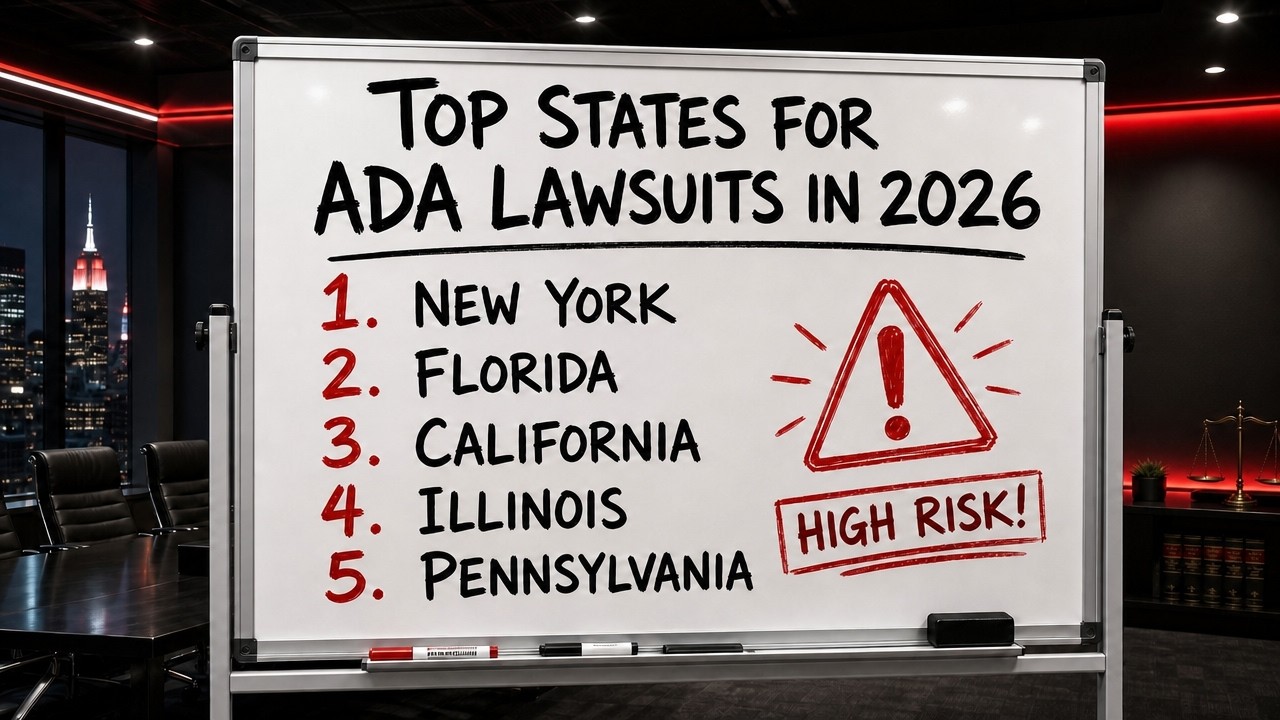
The Ninth Circuit: Covers California, Washington, Arizona, Nevada, Oregon, and other western states. This is a crucial jurisdiction as California is a hotbed for ADA litigation.
The Third Circuit: Covers Pennsylvania, New Jersey, and Delaware.
The Sixth Circuit: Covers Michigan, Ohio, Kentucky, and Tennessee.
The Eleventh Circuit: Covers Florida, Georgia, and Alabama. (Note: The Gil v. Winn-Dixie case in this circuit has a complex history, but recent rulings have leaned toward a strict interpretation that benefits businesses with no physical presence, though this is frequently litigated).
Strategic Implication: If you operate a purely online business and are sued in a federal court within the Ninth Circuit, your defense attorney may be able to file a motion to dismiss on the grounds that your website is not a place of public accommodation because it lacks a physical nexus.
Jurisdiction Type 2: The "Pure E-Commerce" Liability
In direct contrast to the nexus theory, other courts have taken a broader interpretation of the ADA. These jurisdictions argue that the intent of the ADA was to provide equal access to all aspects of public life, and in the modern era, that includes the internet.
The "Standalone" Website Theory
In these courts, a website itself is considered a place of public accommodation. It does not matter if the business has a physical address, a showroom, or a storefront. If you sell goods or services to the public via a website, you are subject to Title III of the ADA.
This interpretation is the most dangerous for online-only retailers. Arguments that the business lacks a "physical gate" to exclude customers are generally rejected. If the website is inaccessible to a blind or hearing-impaired user, the business is liable for discrimination.
Where Does This Apply?
The courts most hostile to pure e-commerce businesses are generally found in the Northeast and parts of the Midwest:
The First Circuit: Covers Massachusetts, Maine, New Hampshire, and Rhode Island.
The Second Circuit: Covers New York, Connecticut, and Vermont. New York is one of the most litigious states for ADA website claims.
The Seventh Circuit: Covers Illinois, Indiana, and Wisconsin.
Strategic Implication: If your online-only business is sued in New York (Second Circuit), arguing that you have no physical store will likely fail. In these jurisdictions, the defense strategy must shift from challenging jurisdiction to challenging the plaintiff's standing, proving mootness (if the site is already fixed), or negotiating a cost-effective settlement.
Determining Your Exposure: The "Long-Arm" of the Law
Business owners often ask, "My business is registered in California, so I'm safe, right?" Not necessarily.
ADA lawsuits can be filed where the plaintiff resides, provided your business conducts substantial commerce in that state. If you are a California-based e-commerce store (Ninth Circuit/Nexus required) but you ship products to customers in New York (Second Circuit/No Nexus required), a plaintiff in New York can sue you in a New York federal court.
This "long-arm jurisdiction" means that practically every online retailer in the United States is potentially exposed to the stricter interpretation of the law, regardless of where their headquarters are located.
In fact, our law firm has represented businesses from across the U.S., and across the world, in ADA website lawsuits in "pure e-commerce" states, many of whom are very surprised to be sued in a state where they have no ties or connections.
Why the "Nexus" Distinction Matters for Your Defense
Understanding the difference between these two judicial interpretations allows your legal team to craft the most cost-effective defense strategy.
1. Motion to Dismiss vs. Settlement
In a nexus jurisdiction, an online-only business has a strong legal basis to request the case be thrown out immediately. This avoids the costly discovery phase of a trial. In a non-nexus jurisdiction, a motion to dismiss based on the lack of physical presence is a waste of legal fees; resources are better spent on rapid remediation and settlement negotiation.
2. Leveraging Venue
If a lawsuit is filed in a fairly hostile jurisdiction against a business with no ties to that state other than a website, a defense attorney may file a motion to transfer venue. Moving the case to a jurisdiction that favors the "nexus" rule can effectively end the lawsuit.
3. Calculating Risk
Knowing which circuits allow suits against pure e-commerce sites helps businesses prioritize their accessibility audits. If you market heavily to customers in the First, Second, or Seventh Circuits, your compliance urgency is significantly higher.
Frequently Asked Questions
If I am an online-only business, can I ignore ADA lawsuits?
No. Ignoring a federal lawsuit is always a bad idea, and will result in a default judgment against you. The court will order you to pay the plaintiff's legal fees and damages, and enforce a strict timeline for fixing your website. Even if you believe the law is on your side regarding the "nexus" requirement, you must formally respond to the complaint through an attorney to assert that defense.
Does a warehouse count as a "physical nexus"?
Generally, no. A "nexus" usually requires a place where customers can visit, such as a showroom or retail counter. A warehouse that is closed to the public and used strictly for fulfillment typically does not establish a nexus for public accommodation purposes. However, this is a fact-specific inquiry that a lawyer must evaluate.
Can I block visitors from litigious states to avoid lawsuits?
Technically, yes, but it is rarely a sound business strategy. Blocking IP addresses from states like New York or Florida limits your market potential. Furthermore, VPNs make it easy for plaintiffs to bypass such blocks. The most sustainable solution is ensuring your website meets WCAG (Web Content Accessibility Guidelines) 2.1 standards.
Why hasn't the Supreme Court fixed this split?
The Supreme Court has declined to hear cases regarding this specific circuit split in the past. Until the Supreme Court issues a ruling or Congress updates the ADA to explicitly include or exclude websites, this patchwork of conflicting laws will remain.
Next Steps for Business Owners
Take control of your defense today. Contact our law firm to review your case, determine the jurisdiction's stance on physical nexus, and chart a path toward a cost-effective resolution.
















Comments